
Why Does Google Seem to Love Me So Much? The Secret Behind 641 Generative AI Performance Impressions on Search Console
An Unfamiliar Menu in Search Console: What is ‘Generative AI Performance’?
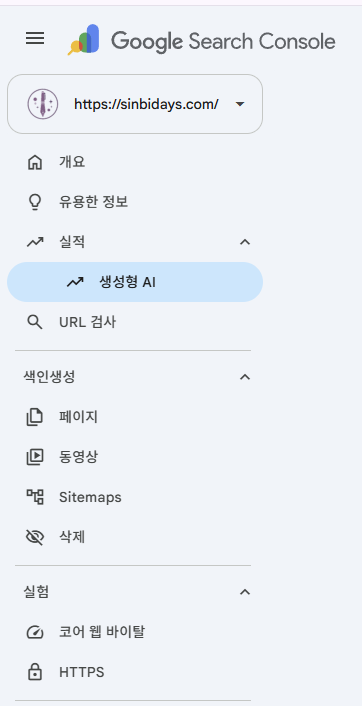
While checking Google Search Console as usual, I noticed an unfamiliar item in the left menu.
‘Performance > Generative AI’
It had a small ‘Beta’ badge next to it, making it look fresh out of the oven.
“What is this?”
Search performance was something I monitored every day, but creating a separate dedicated section for ‘Generative AI’ caught my curiosity.
How does it differ from traditional search performance? And why has Google started showing this data separately now?
Understanding Google AI Overviews and Reference Cards
Nowadays, when you search for complex questions on Google, AI often synthesizes multiple web documents directly above the search results to generate an immediate answer.
This is known as Google AI Overviews.
The AI reviews several web pages, constructs a comprehensive response, and provides source links alongside the answer to back up its information.
In Search Console’s ‘Generative AI Performance,’ you can check how often your blog posts were displayed as cited sources in Google AI answers.
In other words, this isn’t just about showing up somewhere in traditional search rankings; it means Google’s generative AI actively selected my articles as credible references to showcase to users.
It felt surprisingly rewarding to see.
Differences from the Traditional ‘Performance’ Tab
The conventional Performance tab focuses on clicks and impressions from traditional search listings we are all familiar with.
In contrast, ‘Generative AI Performance’ is a dedicated space to examine how your content is exposed directly inside AI-generated summaries.
Reflecting the nature of AI responses, Total Impressions currently stands out as the primary core metric.
At first, I thought it was just another new UI menu, but looking closer into the numbers revealed a fascinating story underneath.
641 Impressions in 28 Days! Why Does Uncle Google Love Me So Much?
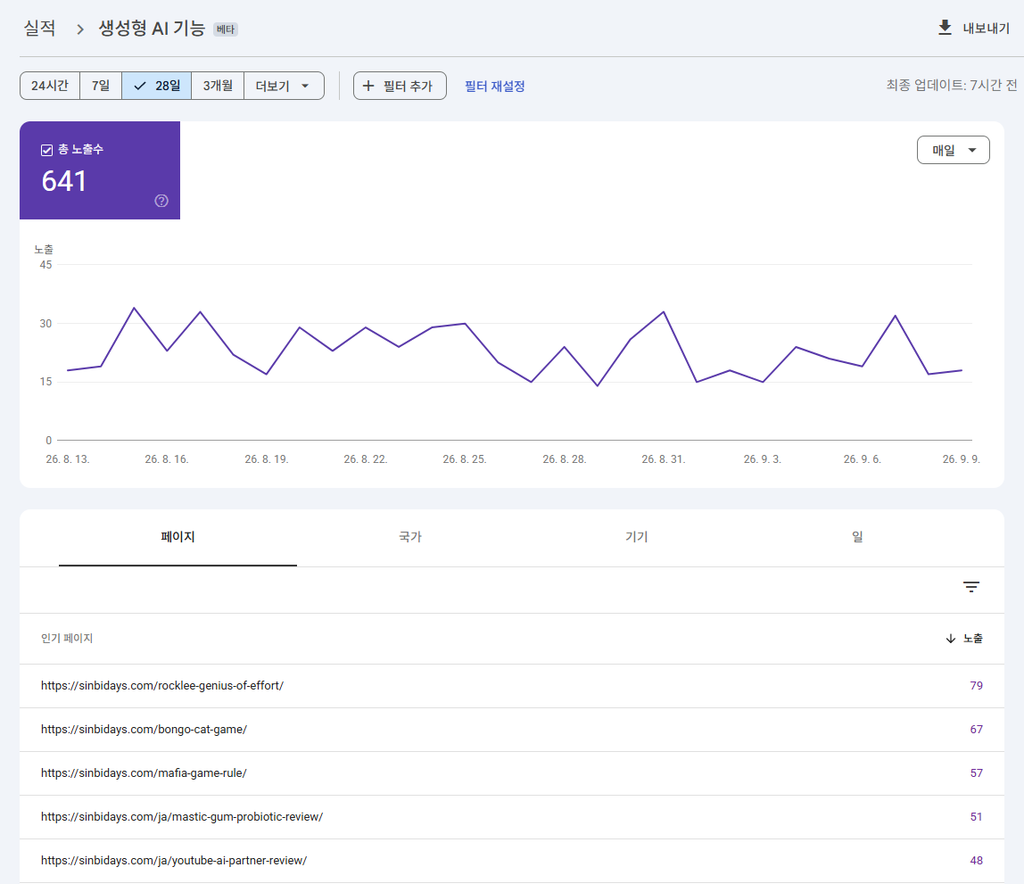
Curious, I extended the date range filter to the last 28 days.
The moment I saw the chart, I couldn’t help but smile.
641 impressions.
That was significantly higher than I anticipated.
Steady Exposure: 20 to 30 Times Every Single Day
What caught my eye even more was that this wasn’t just an accidental one-day spike.
From mid-August into September, generative AI impressions consistently registered anywhere from 15 to over 30 times every single day.
- Total Impressions over 28 Days: 641
- Impressions in the Last 24 Hours: 17
Rather than fleeting one-off traffic, multiple articles across the site were continuously appearing as reference citations inside AI answers.
Looking at that steady line, a playful thought crossed my mind:
“Why does Uncle Google like me so much?”
Haha.
It felt like a moment where a little bit of pride was well-deserved.
“Guess I Really Can Make Anything Work!”
After staring at the dashboard for a while, I said to myself:
“I really can make anything work, can’t I!”
Of course, half of it was just teasing myself.
Yet, it wasn’t completely unfounded confidence either.
It represented the cumulative hours spent writing consistently, building multilingual pages, and methodically refining the site’s content architecture.
No matter how search algorithms evolve, if you consistently deliver valuable content worth reading, the system will eventually discover it.
These numbers gave solid, tangible validation to that quiet belief.
3 Secrets Behind Google AI’s Selection Decoded by Data — Practical GEO Tips

After enjoying the headline figures, I broke down the individual pages earning the highest impressions.
Several common traits quickly emerged among the top-performing pages.
If you are exploring Generative Engine Optimization—often called GEO—these findings offer very practical takeaways.
1. Front-Loaded Structure and Scannable Text Layout
Looking across the pages with the highest generative AI visibility, almost all of them delivered core value right from the start.
Whether examining character analysis or game rules, where searchers need direct answers, these articles skipped lengthy introductory fluff and provided clear definitions right in the opening paragraphs.
Many featured structured bullet points or quick summaries directly under subheadings, making essential details effortless to locate.
Whether it’s an AI crawler or a human reader, everyone wants to extract key insights quickly.
Having a structure where the reader immediately understands what the article covers has become even more vital in the generative AI era.
2. A Multilingual Strategy That Hits the Mark
One of the most fascinating patterns was found on the Japanese translation pages.
Reviewing the top list, pages under the /ja/ directory accounted for 40 to 50+ impressions each.
When I first expanded the blog into multiple languages, a quiet doubt lingered in the back of my mind:
“Will people overseas actually read this?”
Yet looking at this data, real traction was clearly forming within Google’s global AI search ecosystem.
By not limiting the content to Korean alone and translating it systematically, my posts began surfacing in search and AI answers across different language markets.
Watching a modest blog bridge international borders felt genuinely exciting.
3. The Real Paradox of the AI Era: Human Perspective Endures
Diving deeper into the metrics led me to the most profound realization of all.
The more the world is flooded with AI, the more valuable human thought and genuine experience will become.
Synthesizing bare facts or regurgitating generic information already scattered across the web is something AI executes with effortless mastery.
In just seconds, it can spit out a polished, cohesive article.
So why would anyone bother reading someone else’s personal blog in the future?
I believe the answer lies in the creator’s authentic lens.
Raw emotions felt by someone who did the actual work, unexpected stumbling blocks, observant notes on details others overlooked, and personal deductions drawn from lived experiences.
Those elements carry a distinct human warmth that raw informational lists simply cannot emulate.
My blog is filled with reflections of that exact nature.
From philosophical reflections born while collaborating with AI, physical changes observed through heavy training, to direct lessons learned running a business and curious thoughts while playing games.
Perhaps Google AI keeps citing my posts not merely because facts exist on the page,
but because the content carries authentic traces of firsthand human contemplation.
Analyzing these metrics made me believe in that philosophy even more deeply.
Navigating Forward in the Era of AI Search

Watching the new ‘Generative AI Performance’ dashboard in Google Search Console makes it evident that the paradigm of search is shifting.
Where users once typed a query and browsed ten blue links to uncover answers, we are entering an age where AI gathers sources to formulate cohesive answers upfront.
At first glance, this transition might feel intimidating for content creators.
“If AI delivers all the answers directly, will anyone ever click through to my blog?”
Yet, I choose to view it from the opposite vantage point.
As machines grow exceptionally proficient at packaging facts, human readers will naturally value lived experiences and unique viewpoints far above raw information itself.
Reviewing these numbers makes it clear that the era of AI search is no longer a distant theoretical future.
How long it takes to establish complete dominance, no one can pinpoint with certainty.
Yet without question, a day is coming where we will discover information in ways unimaginable today.
Perhaps we have already begun stepping right into the center of that transformation.
How will blogging transform during the AI search era?
If you’d like to explore this topic further, feel free to check out the related article below. 🙂
Moving forward, rather than obsessing over robotic keyword stuffing, my focus will remain on structuring insights cleanly while pouring honest reflections and firsthand lessons into every piece.
Gazing at that number 641 brought a quiet sense of satisfaction.
The posts I’ve poured time into are reaching people across the web, and now they are quietly claiming their place as references inside generative AI answers.
I plan to keep following my genuine curiosities, documenting authentic thoughts, and writing about real things I’ve experienced.
Who knows? Maybe Uncle Google
happens to like that kind of genuine writing much more than we thought.
Haha.