
Seriously— is there a dopamine detox routine faster than meditation? And it only takes 5 minutes!

Hello, this is Shinbi Days. Today I want to talk about something you’ve probably wondered at least once: “Is it possible to detox dopamine faster than meditation?”
I didn’t believe it at first either. Getting out of dopamine addiction in just 3–5 minutes? But when you look closely, this routine is a nervous-system-based strategy designed for speed and efficiency.
🧠 What is dopamine?

Dopamine is a reward hormone that makes us crave and pursue things. It’s linked to joy, pleasure, and a sense of achievement, and it’s usually a helpful substance that motivates us. The problem is that when we’re repeatedly exposed to immediate, intense stimulation, the brain starts wanting only bigger and bigger hits.
This is what people commonly call the “dopamine addiction loop.”
- Scrolling short videos
- Repeated consumption of sexual content
- Gaming, binge eating, over-immersion in social media, etc.
All of these are stimuli that pull out dopamine excessively. In the end, we become lethargic without stimulation.
🧠 Prefrontal cortex vs. primitive brain: an evolutionary psychology view
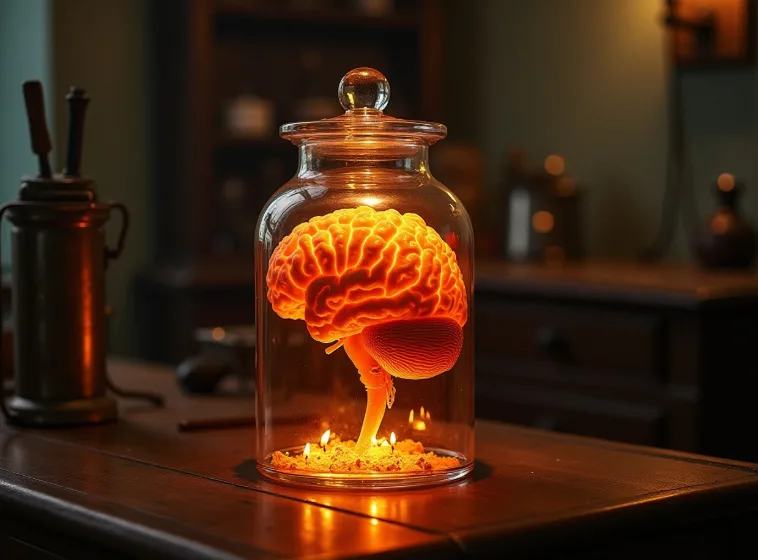
Broadly speaking, our brain can be divided into “the neocortex (especially the prefrontal cortex)” and “the primitive brain (the reptilian brain, including the limbic system)”.
- Prefrontal cortex: responsible for human reason, self-control, focus, long-term judgment, and goal orientation
- Primitive brain: responsible for survival instincts, seeking immediate pleasure, emotional reactions, and fight/flight reflexes
Here’s the problem.
When we fall into the dopamine addiction loop, we ignore the prefrontal cortex’s judgment and end up being pushed around by the primitive brain’s commands.
The primitive brain prioritizes what seems advantageous for survival.
Immediate pleasure, quick rewards, visual stimulation, sensory pleasure. But in today’s world, there’s just too much of it.
So we get tired easily and slip into a lethargic, unmotivated state.
In modern life, there’s so much fake stimulation,
and it’s not helpful for real survival at all.
✨ So what do we need? Breaking the loop with a quick routine

“3-Step Dopamine Reset Routine”
This routine is a simple trigger that helps your prefrontal cortex take the lead again.
✅ Step 1: Spine alignment (30 seconds)
- Sit on the floor or in a chair, and stack your posture from your hips,
- draw your navel inward, and lift your ribcage.
- Tuck your chin slightly and align as if you’re lifting the crown of your head toward the sky.
⚡️ Effect: Restores neural flow, relieves brainstem pressure, and kick-starts your return to focus!
✅ Step 2: Sensory focus (1 minute)
- Close your eyes and focus only on the area you feel most strongly in your body.
(e.g., toes, heart, fingertips, roof of the mouth, etc.)
⚡️ Effect: Sensation breaks the dopamine loop and anchors you in this moment.
✅ Step 3: Repeat affirmations (2 minutes)
“I am awake right now.” “I’ve returned to this moment.” “I’m coming back to my true self.”
- Repeat them out loud, or say them quietly in your mind.
- What matters is repeating them in a steady rhythm.
⚡️ Effect: The prefrontal cortex reactivates, brain circuits get organized, and the stimulus loop weakens.
⏱️ Total time: just 3–5 minutes!
If meditation is a deep-dive cleanse,
this routine is an instant stop button that cuts off the contamination.
Once it becomes a habit, you can pair it with meditation—and it becomes one of the best routines for catching your early reactions to stimulation.
✨ Closing
Meditation is powerful, but when stimulation spikes fast, you need a quick reset first. Let’s gradually reclaim the strength of the prefrontal cortex and restore leadership over body and mind.
Try this routine just once.
Surprisingly, you’ll be able to feel your motivation and focus coming back.
In the next post, I’ll cover the real physical symptoms dopamine addiction can cause in the body. Wishing you a grounded day today 🧘