How Quantum Computers Work—and My Thoughts on Consciousness and Waves
1. Introduction
There’s a term that’s been showing up a lot in the news and articles lately: quantum computers.
They say they’re thousands—tens of thousands—of times faster than conventional computers, and that they’re a technology that could change humanity’s future.
But for now… most people still wonder, “What is it about this that makes it so amazing?”
If we break it down simply, it’s surprisingly straightforward—so shall we take a look together?
2. The Basic Principles of Quantum Computers

Bit vs. Qubit
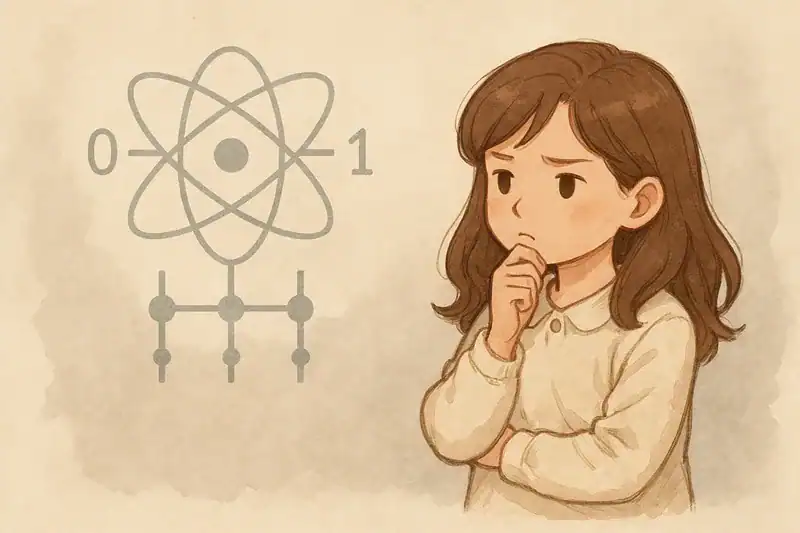
- The computers we use store information as simple signals: 0 and 1.
- Quantum computers, on the other hand, store information in a unit called a qubit (Qubit)—and that’s what makes them special.
- A qubit has the property that it can be 0 and, at the same time, also 1.
I’ll explain this part in an easy way below 😀
👉 Put simply, imagine tossing a coin. Before it lands—while it’s still in the air—the coin could become heads or tails. That’s superposition.
Entanglement
This refers to a phenomenon where qubits are linked so that once one side’s state is determined, the other side is determined at the same time.
For example, if two coins were entangled, the moment one becomes heads, the other would automatically become tails.
Interference
When waves overlap, some parts get amplified and others cancel out.
Quantum computers use this principle to strengthen states that are more likely to be correct and erase the wrong ones.
In the end, when you observe it, the answer you want just “pops” out.
3. Why Is It So Hard?

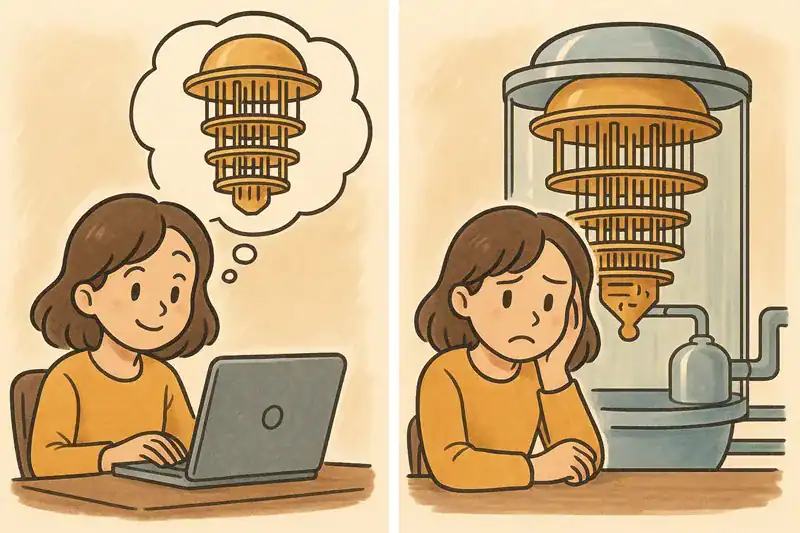
On paper it looks amazing and flawless, but in reality it isn’t easy.
- It breaks down too easily
Because qubits are wave states, they collapse easily even with tiny noise or vibrations.
This is called decoherence, and if the state falls apart mid-calculation, the answer can end up wrong. - It requires an ultra-low-temperature environment
To stabilize qubits, you need -273°C—an environment almost like outer space.
That’s why quantum computer systems come with massive cooling equipment. - The error rate is high
Today’s quantum computers often produce unstable results. That’s why so many researchers are working on error-correction technology.
So the idea is incredibly cool, but the reality is that it’s still “a technology you can only run properly in a lab.”
But I think these error phenomena aren’t just about the environment—I think they’re a matter of consciousness.
It collapses easily even with small noise or vibrations,
it needs a cosmic environment like -273°C,
and the results often fluctuate…
I believe this is deeply connected to quantum consciousness.
It may feel a bit unfamiliar at first, so I’ll briefly explain it below.
3.5. The Double-Slit Experiment – Observation Changes the Outcome
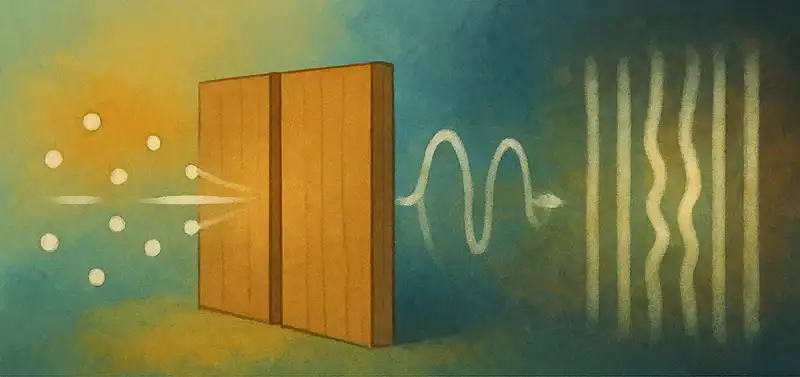
There’s a classic experiment you can’t leave out when explaining the quantum world: the double-slit experiment.
- You fire tiny electrons or particles of light at a wall with two slits.
- If the particles were simply “little pellets,” they should pass through the two slits and leave only two lines on the wall behind them.
- But in reality, electrons behave like waves and create an interference pattern, like overlapping ripples.
What’s even more surprising is that if we try to observe which slit it passes through, the result changes.
The moment observation begins, the electron behaves not like a wave but like a particle, the interference pattern disappears, and only two lines remain.
👉 In other words, before observation, the electron holds multiple possibilities at once as a wave state, and the moment we observe it, it collapses into one of those possibilities.
Our Consciousness Is Also Waves and Frequencies
It’s not easy to fully understand the quantum world of consciousness.
But you’ve probably had a similar experience in everyday life.
When you held a strong conviction like “This will definitely happen this way,”
and then things really unfolded exactly as you thought.
They say experiences like this happen more often when you’re in a positive emotional state—meaning a higher frequency.
The thoughts you hold inside create a force that gets “locked in” through observation in external reality.
A positive state is, in the end, a heart that holds love.
Thoughts that come from love, even when they become reality, make the world more balanced and lead to growth.
What about a negative state of mind?
If even those thoughts all became reality, the world might collapse in no time.
So maybe negative consciousness wavers and fades away—or simply doesn’t come true.
That’s how the world can keep going and find balance again.
You see this message often in songs and books, too.
The song “As You Say” from the variety show Infinite Challenge,
and Neville Goddard’s book I Am That,
both convey the same truth in different language.
▼ How to raise your frequency and vibration (affirmations)
The Connection to Quantum Computers
The qubits in a quantum computer are similar in this way.
- During computation, they use wave-like properties—holding 0 and 1 at the same time—to explore an enormous number of possibilities simultaneously.
- But the moment you read the result, the qubit becomes fixed as either 0 or 1.
So you could say a quantum computer is like something that keeps calculating as a wave, then makes a decision through observation at the very end.
That’s also the biggest difference from a conventional computer.
4. My Interpretation – Consciousness and Waves

I’ve had this thought.
“Maybe the real reason qubits collapse isn’t the environment, but our consciousness as the observer?”
Science usually says qubits break down because of temperature, vibration, and external interference.
But if you remember that quantum computers exist as waves, and that our consciousness is also waves and vibration, the story changes.
- A regular computer has fixed circuits, so it produces results no matter what you imagine.
- But a quantum computer is a wave state—so if the observer’s consciousness unconsciously expects “It’ll probably be 0,” couldn’t that wave interfere?
- Then sometimes it would settle on 0, sometimes on 1, and it might even wobble unstably between the two—creating errors.
That consciousness itself has frequencies is already scientifically known. Brainwaves like alpha, theta, and gamma are well-known examples.
If so, our thoughts and emotions can ultimately be called a kind of wave.
Imagining that quantum computers and human consciousness influence each other—I think that’s meaningful enough to consider.
5. An Emotional Conclusion

Quantum computers still have many limitations. But when I look at this technology, I feel it may not be just a mechanical issue—it may be a world connected to human consciousness, too.
The experience of having scattered thoughts, and then at some point your emotions clear and you feel, “Ah, now I get it,” and everything resolves.
It resembles how a qubit wavers among many possibilities and then, at some moment, snaps into a single definite state.
External factors like temperature and vibration might be excuses.
Maybe our consciousness interferes with them and changes things.
What really matters is what kind of consciousness we’re observing with.
If so, errors in quantum computers might ultimately be interference created when consciousness and the machine resonate at different frequencies.
This is what I want to believe.
The future of technology depends not just on computing power, but on what kind of waves our consciousness and heart are sending.
Thank you.
This was Shinbi Days 🙂



![💚 [Review] A Ray of Light on a Tiring Day: Receiving the IVE An Yu-jin ‘Narasarang Card’ 💌](https://sinbidays.com/wp-content/uploads/2026/02/An-Yu-jin-Card-1024x539.jpg)